 Hola
HolaLanguage training is the one benefit employees actually use
Why language training beats every other workplace benefit in 2026: real data on employee engagement, usage, and what makes a program actually work.

Content
Ask your employees which benefit they'd most like to have, and language training will probably come up early. Ask someone who already has it why they value it, and you'll rarely hear about a certificate or a level exam. You'll hear about getting through a call with an international client without losing the thread, reading an email without reaching for a translator, or finally putting yourself forward for that promotion that requires a B2.
This article looks at what recent data tells us about the gap between the benefits companies think they're offering and what employees actually experience, why language training is one of the few benefits people notice within the first week, and what it takes to build a programme your team will actually use.
The gap between what companies offer and what employees feel
What's the "Great Gap" in workplace benefits?
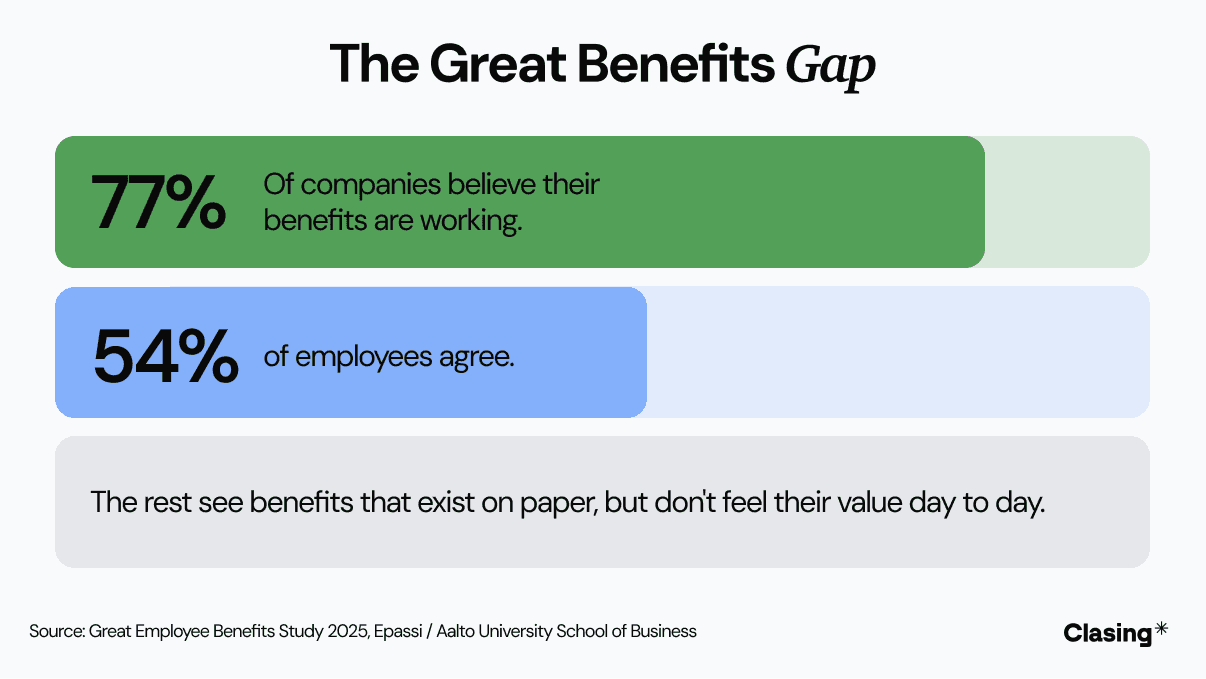
Companies think their benefits are working. Barely half their employees agree.
For years, benefits packages looked the same everywhere: health insurance, meal vouchers, maybe an extra day off here and there. Fine for keeping up with the market, but rarely enough to give a company a real edge in attracting and keeping people.
The Great Employee Benefits Study 2025 (GEBS 2025), run by Epassi and Aalto University School of Business across a sample of 6,000 employees and 1,435 HR leaders and managers in Europe, put a name to this disconnect: the Great Gap. 77% of companies believe their benefits are genuinely effective. Only 54% of employees agree.
That's a striking number for anyone in HR or L&D. Almost half of employees feel a real distance between the benefits pitched in an onboarding deck and the ones they actually experience day to day. More often than not, the gap comes down to one thing: whether people actually use those benefits and feel they're worth something.
Why having a benefit isn't the same as using it
What does a company actually lose when nobody uses its benefits?
Engagement. And that's precisely where Europe is falling short.
Gallup's State of the Global Workplace report puts European employee engagement at just 13%: the lowest of any region worldwide, and well below the global average, for the fifth year running.
At that level of disengagement, choosing the right benefits stops being a nice-to-have and becomes a genuine strategic call. A benefit employees actually turn on, use every week, and see real progress from does more for engagement than ten benefits sitting unused in a policy document somewhere.
Why language training stands out from day one
Why does learning a language carry more weight than other kinds of training?
Because it's one of the rare benefits people can feel working in their daily life, right from the first week.
Among all the things that fall under "professional development," language has one edge almost nothing else can match: you feel the difference immediately.
An employee who's improving their English doesn't need to wait for a certificate to know it's working. They feel it the first time they follow a call with an international client without missing a beat, answer an email without copying it into a translator, or finally speak up in a meeting they'd normally sit through in silence. That immediacy matters even more in frontline industries - hospitality, food & beverage, automotive, machinery - where language is the tool a team relies on to serve an international customer, read a technical manual, or coordinate with suppliers abroad.
For companies competing for talent across global teams, a solid language program becomes a retention lever and an internal mobility lever at once. There's a personal side to it too: a new language travels with you. It's there when you watch a show without subtitles, or finally hold a conversation with your partner's family. Few benefits blur the line between work and life this well, and that's exactly why employees end up feeling it's theirs.
Why most corporate language programs fall flat
Why do so many language programs fail as a benefit?
Because most are built to tick a box on the benefits list, not to get used week after week.
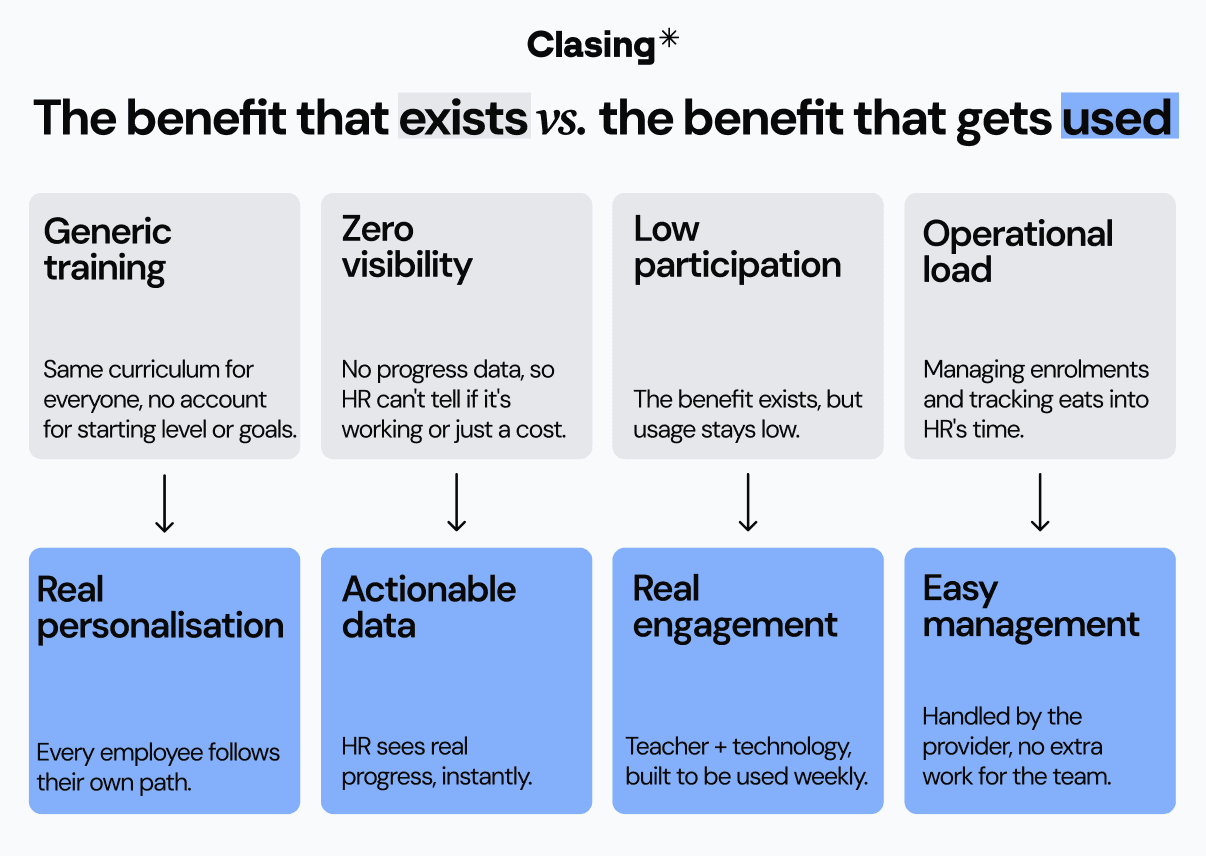
Offering language training is easy. Running it well is a different matter entirely:
- One-size-fits-all content. The same curriculum for everyone, regardless of starting level or goals, leaves some people bored and others completely lost.
- No visibility for HR. Without data on progress or actual usage, there's no way to tell whether the benefit is working or has quietly turned into a cost with nothing to show for it.
- Low usage. With traditional providers, sign-up numbers look great and usage doesn't. The benefit exists on paper; almost nobody logs in.
- A heavy operational load. Managing enrolments, schedules, and follow-up for every employee eats into time most HR teams simply don't have.
The end result is a benefit that looks great in a slide deck and quietly falls apart in practice. A benefit nobody uses can't build engagement.
What it takes to build a language program people actually use
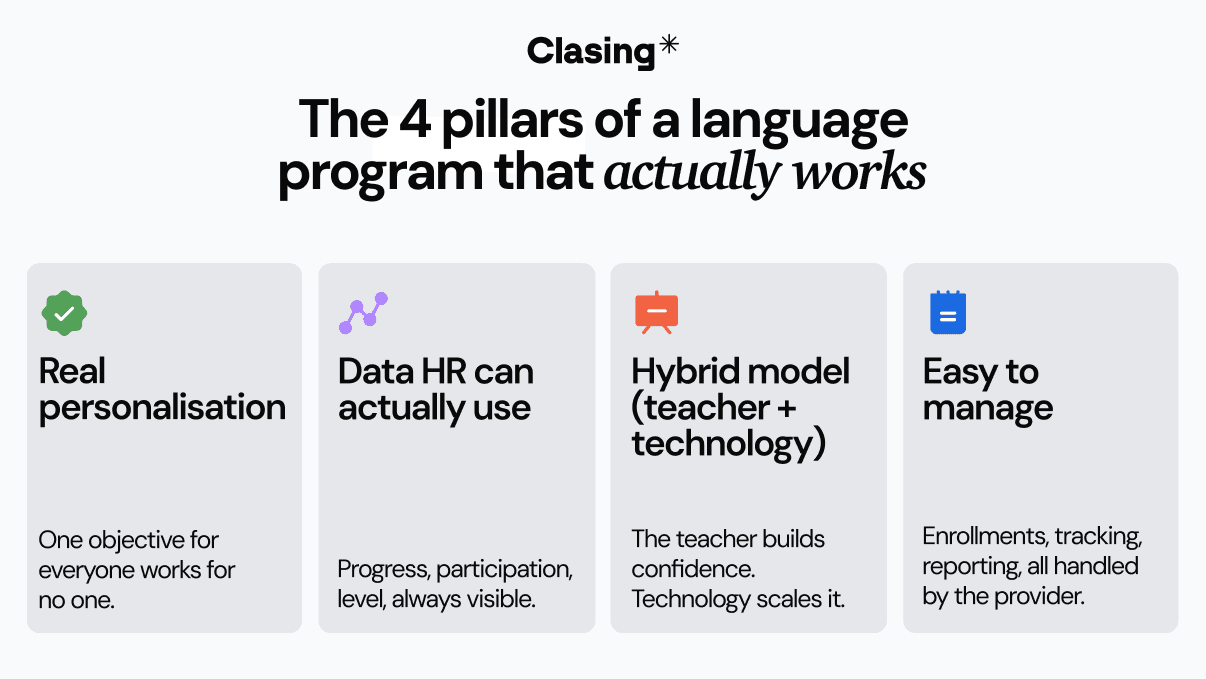
This is what people analytics calls an "activated benefit": something designed from day one to get used every week, not just listed in a catalogue. Getting there means building on four pillars:
- Real personalization. Every employee starts at a different point and needs something different: coaching a salesperson to negotiate in English is a completely different job from teaching a technician to read manuals in German.
- Data HR can actually use. Progress, attendance, level reached — the kind of information HR can pull up and take straight to leadership, no chasing reports required.
- A hybrid model: teacher plus technology. Nothing replaces a native-speaking teacher when it comes to building the confidence to speak. Technology is what lets that learning adapt to each person and scale across an entire company without piling more work onto HR.
- Easy to manage. Enrollments, tracking, reporting; all handled by the provider, so HR gets its time back.
How Clasing builds language training
Does AI replace the teacher at Clasing?
No: in every class, Ari works alongside a native-speaking teacher, making their work go further.
At Clasing, we build every language programme on those four pillars. Each employee learns with a native speaking teacher and with Ari, the artificial intelligence running the whole Clasing ecosystem. Ari reads each person's real level, shapes their learning path, and adjusts content in real time as they progress. It's there to make the teacher's work go further, never to take their place.
For HR, that means constant visibility through the Business Manager: level, progress, and participation for every employee, with data ready to walk into a leadership meeting without a spreadsheet in sight. Language training earns its spot among the benefits that genuinely drive engagement because it's one of the few people notice every single week, at work and beyond. What separates a benefit that works from one that just sits on paper comes down to how it's designed and run. These days, managing language training sits at the center of any real retention strategy.
Want to see what a language program built for real weekly use would look like for your team? Let's talk.